Marrakech's medina disorients you on purpose — or at least it feels that way. The alleys branch and double back, the landmarks disappear when you try to navigate by them, and every direction has an equal claim to being the right one. I was properly lost for two hours on my first afternoon. By my third day I was navigating by smell and sound as much as sight. The medina rewards persistence in a way few urban environments do.
Best Time to Visit Morocco
- March–May: The finest window — warm days (22–28°C), cool nights, wildflowers across the Atlas Mountains, and rose harvest season in the Dadès Valley (early May). Perfect for desert, mountains, and imperial cities simultaneously.
- September–November: Equally excellent. Temperatures dropping from summer peak, date harvest season in the south, and the Sahara at comfortable temperatures. The clearest Milky Way viewing of the year from the desert.
- June–August: Coastal cities (Essaouira, Asilah) benefit from Atlantic breezes. Inland cities (Fes, Marrakech) can hit 42–45°C — schedule sightseeing before 11am and after 5pm. Ramadan (dates shift annually) transforms Moroccan cities at sunset: the iftar meal creates extraordinary communal atmosphere but some restaurants close during daytime.
- December–February: Atlas Mountain skiing, clear Sahara nights, and Marrakech and Fes at their most atmospheric with small crowds. Nighttime temperatures in the desert can drop to 0°C — pack layers even for winter desert trips.
Marrakech: The Red City
Morocco sits at a genuinely extraordinary cultural intersection — Berber, Arab, Saharan African, and French colonial influences layered over each other in ways that produce a country unlike anywhere else in the region.
Marrakech is Morocco's most visited city and its most immediately overwhelming — a walled medieval medina of 1,200 monuments, 150 souks, and the extraordinary Djemaa el-Fna square where snake charmers, acrobats, storytellers, and food stalls converge nightly in a display of human performance that has operated continuously for 1,000 years (it's a UNESCO Intangible Cultural Heritage). The city rewards those who stay at least 3 days and penetrate beyond the main tourist circuit into the residential quarters of the medina.
Marrakech Essentials
- Bahia Palace: A 19th-century vizier's palace of carved cedar, painted plaster, and tiled courtyards — one of the finest examples of Moroccan architecture and craftsmanship and almost always less crowded than the Saadian Tombs nearby
- Majorelle Garden: The cobalt-blue garden created by French painter Jacques Majorelle, later rescued by Yves Saint Laurent — a surprisingly peaceful oasis from the medina's intensity (€7, book online to avoid queues)
- Saadian Tombs: Discovered in 1917 after being sealed for 200 years — the royal necropolis of the 16th-century Saadian dynasty, its carved plaster and cedar wood preserved by the very sealing that concealed it
- Tanneries at dawn: The Chouara tannery visible from surrounding riad rooftops — the dyeing pits operating by methods unchanged since the 11th century, most vivid in morning light (free from riad rooftop viewing platforms above the leather shops)
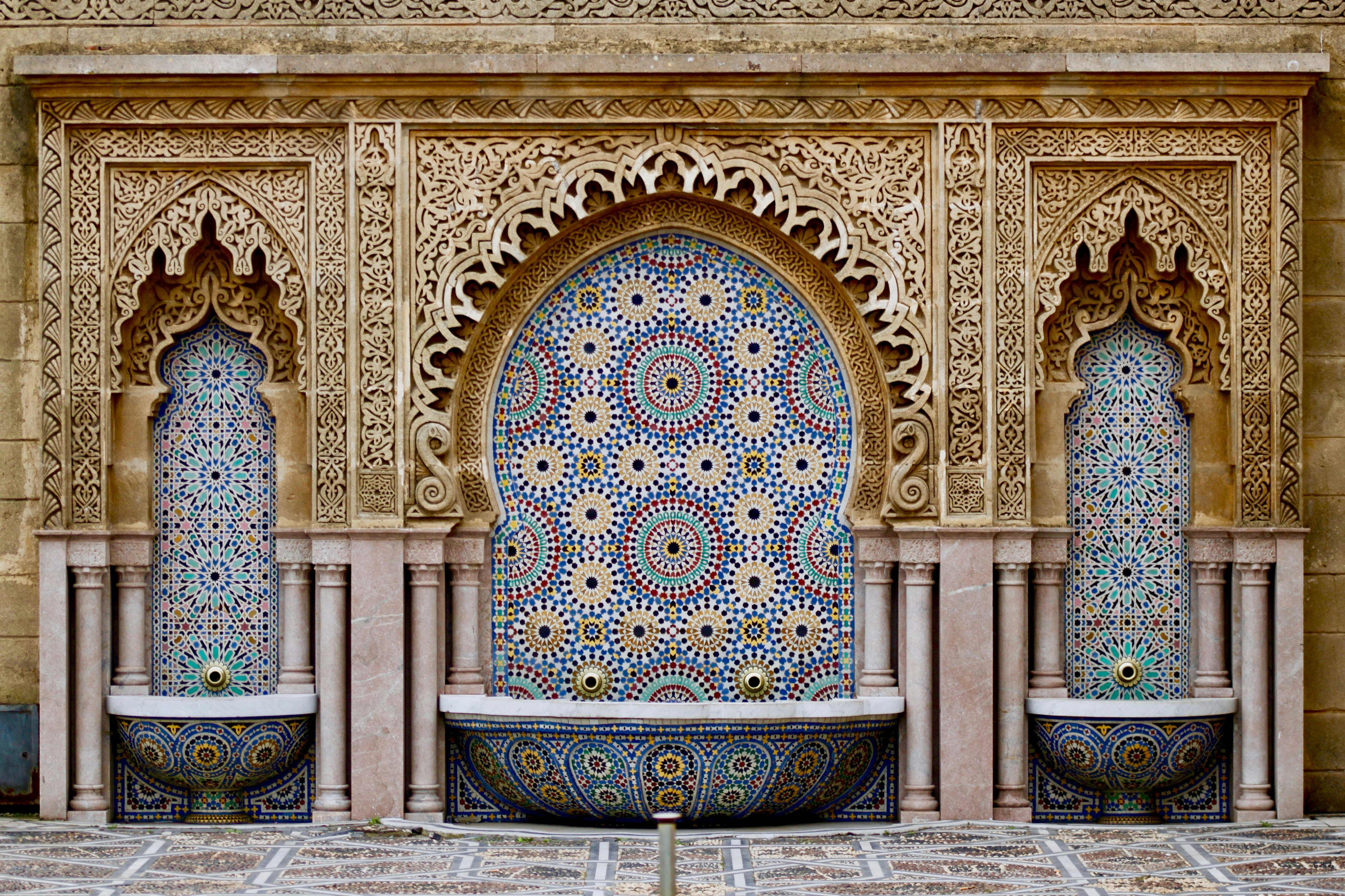
Stay in a riad — a traditional Moroccan townhouse with an interior courtyard — rather than a hotel. Riad accommodation ranges from €40–€300/night and provides the defining Morocco domestic architecture experience. The exterior of a riad is intentionally modest (blank walls facing the street); the interior courtyard, fountain, and tiled floors are where the design energy is directed. Book using our hotel savings strategies for the best riad rates.

Fes: The Living Medieval City
Fes el-Bali (Old Fes) is the world's largest urban car-free zone and the most complete medieval city in the Arab world — a UNESCO World Heritage Site of 9,400 winding lanes, the world's oldest university (University of Al Qarawiyyin, founded 859 CE), and crafts workshops producing the same goods by the same methods for a thousand years. Getting lost in Fes is not a navigation failure — it's the experience. The medina's spatial logic follows human movement patterns rather than grid planning, and the result is a city that genuinely cannot be understood from a map.
Hire a local guide for the first half-day — not to be herded to souvenir shops, but to orient yourself to the medina's spatial organization and see the craftspeople (brass workers, weavers, leather tanners, ceramic artists) in their workshops. After orientation, explore independently. The neighborhood of Andalous quarter on the medina's east bank is larger than Fes el-Bali and almost entirely unvisited by tourists — an extraordinary contrast in density and atmosphere.
✈️ Book Your Morocco Adventure
Find cheap flights to Marrakech or Casablanca and book your riad accommodation.
✈ Search Flights 🏨 Book Hotels 🎫 Book ToursThe Sahara Desert Experience
The Moroccan Sahara — accessed from the villages of Merzouga and M'Hamid in the southeast — provides North Africa's most accessible desert experience. The orange dunes of Erg Chebbi (Merzouga) rise 160m from the flat desert floor; a camel trek into the dunes for a sunset camp is the classic experience, available for €80–€150 per person including a night in a luxury desert camp with dinner, entertainment, and sunrise camel return.
The drive to Merzouga through the Draa Valley and the Dadès and Todra gorges is among Morocco's finest road journeys — a rental car from Marrakech allows independent exploration of kasbahs, oases, and the extraordinary landscape of palm groves and red earth that characterizes the pre-Saharan region. Our car rental guide covers Morocco-specific rental advice including navigation in the south where GPS coverage can be limited.
Essaouira: The Windy City
Essaouira's whitewashed and blue-shuttered medina on the Atlantic coast — a UNESCO World Heritage walled city of Portuguese and Moorish architecture — is Morocco's most relaxed and visually distinctive city. The consistent Atlantic wind makes it kite surfing's global capital (dozens of schools on the beach, €60–€90 for a beginner's lesson); the same wind keeps summer temperatures at 22–24°C while Marrakech swelters. The ramparts walk, the blue fishing boats in the harbour, the gnawa music emanating from medina workshops, and the extraordinary fresh seafood grilled on the port quay at €4–€8 for a full plate make Essaouira a deserved counterpoint to Marrakech's intensity.
Moroccan Cuisine: One of Africa's Finest
- Tagine: The conical clay cooking vessel and the slow-cooked stew prepared in it — lamb with preserved lemon and olives, chicken with saffron and almonds, vegetable with ras el hanout (a spice blend of 20–30 ingredients). Found everywhere from roadside restaurants (€4–€6) to fine dining riads (€25–€40).
- Couscous: The Friday meal throughout Morocco — semolina steamed over broth and topped with meat, root vegetables, and chickpeas. The version available in homes and traditional restaurants bears no resemblance to the instant supermarket product.
- Pastilla (B'stilla): Filo pastry filled with slow-cooked pigeon (traditionally) or chicken, almonds, and eggs, dusted with cinnamon and powdered sugar — sweet-savoury complexity that defines Moroccan cuisine's Andalusian influence.
- Harira: The thick tomato, lentil, and chickpea soup served to break the Ramadan fast — available year-round in traditional restaurants for €1–€2 as a complete first course.
Eat where Moroccans eat: the street food of Djemaa el-Fna (snail soup, merguez sausages, harira, spiced nuts) provides the widest variety for €2–€5 total. The pastillerie culture (pastry shops serving Moroccan sweets with mint tea) is Morocco's answer to the café — an institution of extraordinary sweetness and warmth. Our food travel guide places Fes and Marrakech in the world's top 20 food cities.

Morocco Budget Guide
Morocco is excellent value by any international comparison:
- Budget: $30–$50/day (budget riad dorm or cheap guesthouse, street food and local restaurants, shared transport)
- Mid-range: $70–$120/day (private riad room, restaurant meals, guided tours)
- Comfortable: $150–$300/day (luxury riad, fine dining, private driver)
Apply our budget travel strategies throughout Morocco — the country rewards patient explorers who look slightly off the tourist circuit with authentic experiences at dramatically lower prices. Use our flight comparison tools to find cheap flights to Marrakech (RAK), Casablanca (CMN), or Fes (FEZ) — all three are served by multiple European low-cost carriers.
Morocco's Imperial Cities: A Four-City Circuit
Morocco's four Imperial Cities — Marrakech, Fes, Meknès, and Rabat — each served as the country's capital at different points in its history. The circuit connecting them represents Morocco's most concentrated historical experience:
Meknès is the Imperial City that most travelers skip — a mistake, because Moulay Ismail's 17th-century capital contains the Bab Mansour (the finest ornamental gate in Morocco), the vast granaries and stables of the royal complex, and a far more authentic medina atmosphere than either Marrakech or Fes at this point in Morocco's tourism development. The day trip from Meknès to the Roman ruins of Volubilis (UNESCO) — one of the best-preserved Roman cities in North Africa, with extraordinary mosaic floors still in situ — adds an entirely unexpected civilizational layer to a Morocco itinerary already rich with Islamic and Berber history.
Rabat is Morocco's actual capital and least-visited Imperial City — a contrast to Marrakech's tourist saturation that provides the most authentic engagement with contemporary Moroccan urban life. The Hassan Tower (an incomplete 12th-century minaret that would have been the world's largest mosque), the Chellah Necropolis (Roman and Merenid ruins within the same walls, occupied by storks and a resident colony of cats), and the peaceful seaside Oudayas Kasbah create a city of considerable charm. Combine the circuit by train — Morocco's train network (ONCF) connects the northern cities efficiently and cheaply, and includes the Casablanca–Marrakech line.
The High Atlas Mountains
The High Atlas range rising directly south of Marrakech to peaks above 4,000m provides Morocco's finest trekking and a landscape of extraordinary contrast with the desert regions to the south. Jebel Toubkal (4,167m), North Africa's highest peak, is achievable by fit trekkers without technical climbing equipment — a 2-day summit attempt from the trailhead village of Imlil (90 minutes from Marrakech) via the Neltner refuge hut provides Africa's most accessible high-altitude experience. Late April–June and September–October provide the best conditions; summit snow persists until June most years.
The Berber villages of the Ourika Valley and the Ourika River gorge provide more accessible day trips from Marrakech — the valley's Berber markets (Monday market at Setti Fatma), waterfalls accessible by 45-minute walk, and family-run guesthouses charging €15–€25/night create the authentic mountain Morocco experience that most visitors miss in their rush to the Sahara. Pair with our budget travel destinations guide — Morocco's mountains represent exceptional value combined with extraordinary scenery.
Morocco's Atlantic Surf Coast
Morocco's Atlantic coast has produced some of the world's finest surf breaks — and the surf culture along the coast between Rabat and Agadir provides a completely different Morocco from the imperial cities and desert circuits. Taghazout (near Agadir) is Europe's most popular winter surf destination — the consistent Atlantic swell from October to April attracts surfers from across Europe seeking warm-water waves at accessible prices. Surf camps run by expat instructors provide beginner to intermediate lessons ($40–$60/day including accommodation), while the point breaks of Anchor Point, Boilers, and Killer Point provide world-class conditions for experienced surfers. The town retains a relatively low-key character despite its European popularity — a riad in the medina costs €20–€35/night and tagine costs €4–€6. Combine with our best beach destinations guide for the complete Atlantic Morocco coastal circuit.
Dakhla, 500km further south near the Western Sahara boundary, has become the world's finest kitesurfing destination — flat water lagoons, consistent 20–25 knot winds from March to November, and luxury eco-camps built on sandspits extending into the lagoon attract serious kitesurfers from globally. The journey from Agadir (8 hours by shared taxi or 1.5 hours by Royal Air Maroc domestic flight) is part of the experience — the drive passes through increasingly remote Saharan landscape that makes Dakhla's lagoon arrival genuinely dramatic.
Frequently Asked Questions About Morocco Travel
Is Morocco safe to visit in 2026?
Morocco is generally safe for tourists — one of Africa's most visited countries with a well-developed tourism infrastructure. Standard precautions apply in medinas (be aware of unsolicited guides). Always review current travel advisories and use our travel safety guide.
Do I need a visa for Morocco?
Most Western passport holders (US, EU, UK, Canada, Australia) enter Morocco visa-free for up to 90 days. A valid passport is required. Verify your specific nationality's requirements at Morocco's consulate website before travel.
Should I haggle in Morocco?
Yes — negotiation is expected and culturally normal in souks and with informal taxi drivers (always agree the price before entering). Start at 40–50% of asking price in markets. Fixed-price shops (indicated by signs) are exempt. Approach bargaining as conversation rather than confrontation for the most enjoyable outcome.
What is the best base for Morocco travel?
Marrakech for first-time visitors — best flight connections, widest accommodation choice, and central location for desert trips and coastal day trips. Fes for cultural depth and the most authentic medina experience. Essaouira for a relaxed coastal base. Most visitors combine two or three cities over 7–10 days.