India broke me for the first three days and then became the most captivating place I'd ever visited. The sensory intensity — the noise, the colour, the crowds, the smells, the constant movement — initially felt overwhelming. Then, gradually, I started reading it differently. What looked like chaos revealed its internal logic. What felt overwhelming became fascinating. India is the most demanding and most rewarding destination I've experienced.
Is India Safe to Travel in 2026?

India's safety reality is more nuanced than either the enthusiastic "yes" or the fearful "no" that most travelers receive. The short answer: millions of international tourists visit India safely every year, and serious incidents involving tourists are rare. The longer answer: India requires more situational awareness than most developed-world destinations. Specific strategies:
- Use only pre-paid taxis from airports (booked at the official counter inside the terminal, not touts outside)
- Book accommodation in established tourist areas initially, particularly for solo female travelers (read our women's safety guide for India-specific advice)
- Use Ola and Uber apps for all urban transport rather than street hailing
- Keep copies of all documents in cloud storage
- Purchase comprehensive travel insurance with medical evacuation coverage before departure
Best Time to Visit India
First-time visitors to India almost universally have a difficult first few days and then don't want to leave. I'll try to give you information that makes those first few days easier without removing the genuine surprise that makes India so affecting.
India's climate is deeply regional — the "best time to visit" varies dramatically by destination:
- North India (Delhi, Agra, Rajasthan): October–March is ideal. April–June is extremely hot (40–48°C). Monsoon (July–September) brings cooler temperatures but heavy rain.
- South India (Kerala, Tamil Nadu, Karnataka): October–March in most areas. Kerala's peak season is December–January when the backwaters are at their most beautiful.
- Himalayan Regions (Ladakh, Manali, Darjeeling): May–September for Ladakh. Darjeeling and Sikkim best April–June and September–November.
- Goa: November–February for beach season. Monsoon (June–September) is when Goa comes alive for longer-stay travelers who prefer a quieter, greener atmosphere.
India's Essential Destinations
The Golden Triangle: Delhi, Agra, Jaipur
The classic first India itinerary — three extraordinary cities within 250km of each other, connected by train or road. Most first-time India visitors cover this circuit in 5–7 days before deciding whether to continue deeper into the country.
- Delhi: Old Delhi's Chandni Chowk market (by cycle rickshaw for the full sensory experience), the Red Fort, the Jama Masjid, Humayun's Tomb (Taj Mahal's architectural predecessor), and the craft colony at Dilli Haat
- Agra: The Taj Mahal at dawn — India's most famous monument lives up to every photograph when experienced in person. Arrive at the east gate 30 minutes before opening for the best light and smallest crowds. The Agra Fort is an underrated complement to the Taj.
- Jaipur: The Pink City — Amber Fort (a hilltop Rajput palace approached by elephant or jeep), the City Palace, the extraordinary Jantar Mantar astronomical observatory, and India's best textile and gem shopping
✈️ Book Your India Adventure
Find cheap flights to Delhi and book the best India hotels at great rates.
✈ Search Flights 🏨 Book Hotels 🎫 Book ToursRajasthan: India at Its Most Spectacular
Rajasthan is India's most visually extraordinary state — a desert landscape of elaborate palaces, fortress cities, and a living feudal culture that feels centuries removed from modern India. Beyond Jaipur: Jodhpur's Blue City (Mehrangarh Fort is India's finest), Udaipur's Lake City (floating palaces and romantic haveli hotels), Jaisalmer's golden desert fort-city rising from the Thar Desert, and Ranthambore National Park for tiger safaris.
Getting around Rajasthan: hire a driver for 3–10 days for maximum flexibility (approximately ₹3,000–₹5,000/$35–$60 per day with driver accommodation separate). Private car with driver beats trains and buses for luggage logistics in a region where this is otherwise complex.
Kerala: God's Own Country
India's most literate and developed state is also its most beautiful. The backwaters — a 900km network of lagoons, lakes, rivers, and canals along the Arabian Sea coast — are explored by houseboat, with accommodation, meals, and transport combined in a single extraordinary experience. Fort Kochi's European-influenced port city, Munnar's tea estate highlands, and Kovalam and Varkala's cliff beaches complete a state that offers a fundamentally different India to the north.
Varanasi: The World's Oldest City
Varanasi on the Ganges is unlike anywhere else on earth — a city of Hindu pilgrimage where life, death, and cremation occur simultaneously on the ghats (river steps). The morning boat ride at dawn watching pilgrims bathe in the sacred river, the Ganga Aarti ceremony at sunset, and the complete immersion in Hindu religious culture at its most concentrated make Varanasi an essential but emotionally demanding India experience. Not comfortable — profound.
Mumbai: Maximum City
India's commercial capital and the heart of Bollywood cinema. The Gateway of India, Dharavi (Asia's largest urban village — a complex and organized community, best visited with a local guide), the Victoria Terminus (UNESCO-listed railway station), the Parsi Irani cafés, and Marine Drive's "Queen's Necklace" evening view create a city of extraordinary energy and contradiction. India's best restaurant scene by most assessments.
Goa: Beach and Culture
India's beach capital has two distinct personalities: the developed north (Baga, Calangute, Anjuna — beach clubs, water sports, full tourist infrastructure) and the quieter south (Palolem, Agonda — crescent beaches, yoga retreats, hammocks). Portuguese colonial heritage visible in white-washed churches, spice-infused Goan cuisine, and excellent seafood distinguish Goa from any beach destination in Southeast Asia.
India Transport Guide
- Indian Railways: The world's 4th largest rail network is affordable, comfortable in AC classes, and the best way to experience the country between major cities. Book online at irctc.co.in at least 2–3 months ahead for popular routes — quotas fill extremely quickly. AC 2-Tier (2A) and AC 3-Tier (3A) sleeper classes provide an authentic experience at reasonable prices.
- Domestic flights: IndiGo and Air India connect major cities for $20–$80 booked in advance. Use our flight comparison guide for Indian domestic routes.
- Private drivers: For Rajasthan and state-level exploration, hiring a car with driver (through your hotel or reputable agencies) provides the most efficient and flexible transport.
- Tuk-tuks and auto-rickshaws: Negotiate fares before departing — ask your hotel for the correct fare to common destinations. OLA Auto (app-based) eliminates negotiation in major cities.
India Budget Guide
- Budget backpacker: $25–$40/day (guesthouse, dal makhani and thali restaurant meals, trains)
- Mid-range traveler: $60–$100/day (heritage hotel, good restaurants, private transport)
- Comfortable: $150–$300/day (boutique hotels, tour guide, flight connections)
India is one of the world's best-value destinations — a private heritage hotel in Jaipur or Udaipur costs $60–$120/night that would cost $400+ in Europe. Apply our hotel saving strategies for the best India accommodation deals.
India Food: What to Eat
Indian cuisine is one of the world's greatest — and the regional diversity is extraordinary:
- North India: Butter chicken, dal makhani, biryani, paratha with achaar — the cuisine most internationally recognized as "Indian"
- South India: Masala dosa, idli sambar, rasam — lighter, rice-based, temple-influenced
- Rajasthan: Dal baati churma (the state's defining dish), laal maas (fiery red mutton)
- Goa: Fish curry rice, prawn vindaloo, sorpotel — coconut milk and vinegar-based Portuguese-influenced seafood
Eat where Indians eat — the ₹100–₹200 ($1.20–$2.40) thali at a busy local restaurant is safer, better, and more authentic than tourist restaurants charging 5x the price. Our food travel guide features Indian cities prominently.
✈️ Fly to India at the Best Price
Compare international flights to Delhi, Mumbai, or Bangalore at the lowest fares.
✈ Search Flights 🏨 Book Hotels 🎫 Book ToursThe Taj Mahal: India's Greatest Monument
The Taj Mahal is the most visited building in India and one of the most recognizable structures on earth — and the reality, for almost every visitor, exceeds what the photographs prepared them for. This is rare among globally famous landmarks. Most iconic buildings seem slightly smaller, slightly less perfect in person. The Taj is larger, whiter, and more geometrically exact than memory suggests. It generates a particular silence in the people who stand before it that no other building quite replicates.
Built between 1631 and 1653 by Mughal Emperor Shah Jahan as a mausoleum for his wife Mumtaz Mahal, the Taj represents the apex of Mughal architecture — a synthesis of Persian, Ottoman, and Indian design traditions executed in white Makrana marble inlaid with 28 types of semi-precious stone. The four minarets are constructed at a slight outward angle so that they would fall away from the main building in the event of an earthquake. The garden's pools reflect the entire structure, creating the double-image that photography has made familiar worldwide.
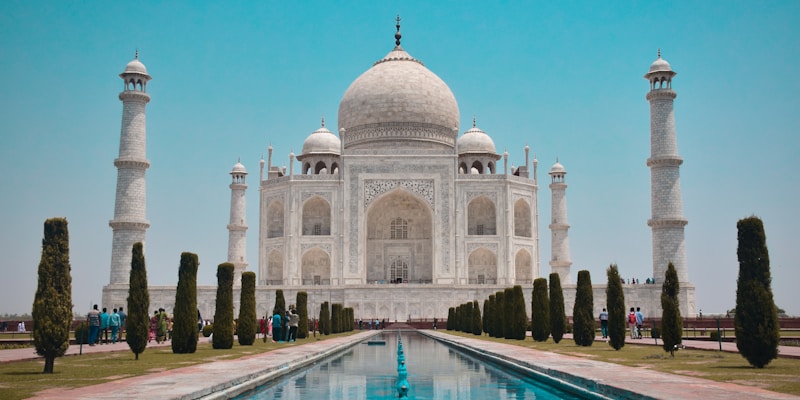
Practical Taj Mahal visit: Buy tickets online at asi.payumoney.com at least 24 hours ahead (mandatory during peak season: October–March). Arrive at the eastern gate 30 minutes before opening — the first two hours provide the best light and the most manageable crowd levels. The Taj closes on Fridays for prayers. Photography is permitted everywhere except inside the central mausoleum chamber itself. The Agra Fort, 2km away, is a 2-hour architectural complement to the Taj that most visitors underestimate.
India's Food: The World's Most Diverse Cuisine
Indian cuisine is not one cuisine — it is a collection of 30+ distinct regional traditions that share some common techniques and spice families but differ as dramatically as French and Japanese food differ from each other. Understanding this before visiting transforms how you eat: seeking out the regional specialties rather than the globally familiar dishes is how India's food reveals itself at its finest.
In Delhi: Karim's near the Jama Masjid has been serving Mughal-influenced meat dishes since 1913 — the mutton korma and seekh kebab represent a living culinary tradition of extraordinary depth. Paranthe Wali Gali in Chandni Chowk serves stuffed flatbreads from small family stalls that have occupied the same narrow alley for generations. Saravana Bhavan's South Indian thali provides the counterpoint: a banana-leaf presentation of sambar, rasam, curries, rice, and pickles representing the entirely different food culture of Tamil Nadu within the same city.

In Mumbai: The dhaba culture (small roadside restaurants) serves the best value food in India's most expensive city — a dal-rice-sabzi meal for ₹80–₹150 ($1–$2) that nourishes millions of working Mumbaikars daily. The seafood at the seafood restaurants of Juhu and Versova reflects Maharashtra's coastal tradition — pomfret, tiger prawns, and surmai (Indo-Pacific kingfish) prepared in coconut and kokum-based curries entirely distinct from anything available in northern India.
Travel and food cannot be separated in India. Use our food travel guide for detailed recommendations by city — Indian food experiences are among the guide's top-rated globally.
India's Transportation System
Indian Railways is the world's fourth-largest railway network — 68,000km of track, 13,000 trains daily, 23 million passengers per day. For travelers, it provides the most affordable and experientially rich way to move between cities. The key is understanding the booking system: classes, quotas, and the difference between trains matter significantly.
AC 3-Tier (3A) is the traveler's standard class — a sleeper compartment with three-tiered berths, air conditioning, bedding provided, lockable storage beneath the lower berths, and the opportunity to have genuine conversations with Indian families, students, and business travelers that provide the most authentic India experience available. Cost: typically ₹500–₹1,500 ($6–$18) for journeys of 6–12 hours. Book at irctc.co.in — the official booking site requires registration but once set up, allows booking up to 120 days ahead when quotas are largest.

For Rajasthan specifically, the Palace on Wheels luxury train provides a royal Indian railway experience — 7 nights through Jaipur, Udaipur, Jaisalmer, and Agra in a carriage restored to Maharaja-era standards. At $350–$600 per person per night (all-inclusive), it is expensive by Indian standards but represents genuine value for the experience delivered. Detailed rail booking strategies are in our trip planning guide.
Domestic flights (IndiGo, Air India, SpiceJet) cover the longer distances efficiently — Mumbai to Kochi (1h 40m, from $25 booked early), Delhi to Leh for Ladakh (1h, from $40), and Delhi to Varanasi (1h 15m, from $20). Compare using our flight comparison tool — domestic India fares are volatile and reward early booking by 3–6 weeks.
Responsible Travel in India
India rewards travelers who approach it with patience, curiosity, and genuine respect for its enormous cultural complexity. Some important principles for responsible India travel:
- Photography permissions: Always ask before photographing people, particularly in rural areas and religious sites. A respectful gesture and eye contact are sufficient — the response is almost universally warm when the request is genuine
- Dress codes at religious sites: Cover shoulders and legs at temples, mosques, and gurdwaras. Carry a light scarf for unexpected entries. Removing shoes before entering religious sites is mandatory throughout India
- Avoid elephant rides: The welfare standards of elephant camps vary enormously — choose camps with ethical credentials (World Animal Protection certification) that allow elephants natural movement and social interaction
- Bargain respectfully: Negotiation is a cultural norm in markets and with tuk-tuk drivers — engage with it cheerfully rather than aggressively. The gap between asking price and genuine value is often significant; the gap between a fair price and an extractive one is usually modest in absolute terms
- Drink only bottled or filtered water throughout India: Tap water safety varies dramatically by city and neighborhood — consistent bottled water use is the most reliable prevention for traveler's illness
Frequently Asked Questions About Visiting India
Do I need a visa for India?
Most nationalities require a visa. The e-Tourist Visa (eTV) is available online at indianvisaonline.gov.in — apply 4–30 days before arrival. The 30-day single-entry and 1-year multiple-entry options are both available. Check our visa guide for your specific nationality.
Is India safe for tourists in 2026?
Yes, with appropriate preparation. Use app-based taxis, purchase comprehensive travel insurance (our insurance guide covers India-specific considerations), book accommodation in established tourist areas initially, and research destination-specific advice for solo female travelers.
What is the best India itinerary for 2 weeks?
Days 1–3 Delhi, Day 4 Agra (Taj Mahal), Days 5–7 Jaipur, Day 8 Jodhpur, Days 9–10 Udaipur, then fly to Kerala or Goa for Days 11–14. This covers India's architectural, desert, and beach highlights in a manageable circuit.
How much does a trip to India cost?
India is among the world's best value destinations. Daily costs: $25–$40 budget, $60–$100 mid-range, $150–$300+ comfortable. A 2-week India trip (excluding flights) costs approximately $500–$1,500 depending on accommodation and transport choices.